North Shore in Duluth in Saint Louis County, Minnesota — The American Midwest (Upper Plains)
Commercial Fishing

Photographed by Cosmos Mariner, June 24, 2024
1. Commercial Fishing Marker
An early spike in commercial fishing along the North Shore began in the mid-1830s, as the American Fur Company established fishing stations to meet demand for Lake Superior whitefish. Although that effort ended in 1842, travel books and visitors' accounts mentioned a seemingly inexhaustible fish supply — a magnet that drew many settlers to the North Shore.
Scandinavian immigrants started North Shore fishing businesses in the 1890s. By 1899, millions of pounds of lake trout, whitefish, and herring were line-caught or taken in gill nets set in open water or under the ice. In 1915, the Duluth area alone harvested a record 10,000 tons of fish.
Between 1920 and the 1960s, fish populations declined due to overfishing, industrial pollution, and the arrival of the parasitic sea lamprey.
During the past thirty years, Lake Superior's fishery has recovered through stocking, natural rebound, sustainable harvest, and lamprey control. Today, commercial fisheries harvest lake trout, whitefish, herring, chubs, siscowet, and smelt. Lake trout and salmon provide sport fishery.
[photo and illustration captions]
• The Sea Lamprey
The sea lamprey,• Northern Fish Company, Dulutha parasitic fish, entered the Great Lakes in 1938 via shipping canals. They cause severe losses of native fish, but their numbers are controlled.
Click or scan to see
this page online
This 1915 ad promoted fresh fish "frozen with the wiggles in their tails." Catches were also smoked, salted, and refrigerated for shipment to market.• Walfred Johnson's Fishing House, Stoney Point, 2011
Old fishing houses, piers, and boats linger along the North Shore, reminders of an industry that shaped a way of life for more than a century.
Topics. This historical marker is listed in these topic lists: Animals • Immigration • Industry & Commerce • Settlements & Settlers.
Location. 46° 52.875′ N, 91° 55.128′ W. Marker is in Duluth, Minnesota, in Saint Louis County. It is in North Shore. It can be reached from the intersection of Congdon Boulevard (North Shore Drive) (State Highway 61) and McQuade Road, on the left when traveling north. The marker is located in the McQuade Small Craft Harbor interpretive kiosk, overlooking Lake Superior. Touch for map. Marker is at or near this postal address:

Courtesy Clifford Sundstrom & Ray Johnson
2. Marker detail: Local Fishermen, late 1940s
John Sundstrom, Leander Johnson (Ice Fishing), and Victor Sundstrom.

Regionally, this marker is in Minnesota’s Arrowhead Region and in the Iron Range. It is also in the American Midwest, on the Great Lakes, and in the Corn Belt. Globally, it is in North America, the Great North Woods, the Western Hemisphere, the Western World, and the Anglosphere. Historically, it finds itself in what was once the Viceroyalty of New France, Rupert’s Land, the territory of the Mississippian Culture, and the Northwest Territory.
Other nearby markers. At least 8 other markers are within 7 miles of this marker, measured as the crow flies: Prospectors & Settlers (here, next to this marker); Highway 61: Road to Tourism (here, next to this marker); Superior: One Great Lake (here, next to this marker); Safe Haven from Wild Winds and Waves (here, next to this marker); Boatwatching (here, next to this marker); Clifton–French River (approx. 1.6 miles away); The Skyline Parkway (approx. 5.1 miles away); Buchanan (approx. 6½ miles away). Touch for a list and map of all markers in Duluth.
Also see . . . North Shore Commercial Fishing Museum (Wikipedia).
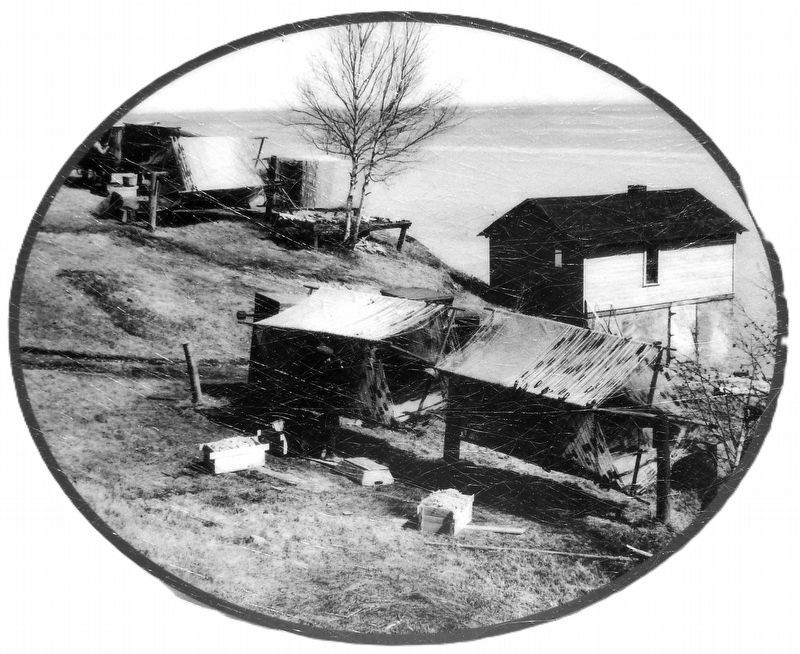
Northeast Minnesota Historical Center, Duluth
3. Marker detail: John Gustafson and John Sundstrom Fishing Hamlet near McQuade Road, circa 1940
Fishing Superior’s waters was rugged, dangerous work. Boats and nets demanded constant care — here, cotton gill nets dry on net rollers to prevent rotting.
Excerpt: The North Shore Commercial Fishing Museum is a museum in Tofte, Minnesota, dedicated to the history of the Scandinavian immigrants and communities of the North Shore region of Lake Superior, and especially their importance to the national commercial fishing industry of the 1880s to 1940s.(Submitted on February 23, 2025, by Cosmos Mariner of Cape Canaveral, Florida.)
The museum traces the development of the commercial fishing industry, with a focus on Lake Superior, fishing families, and fishing techniques of the heyday of the industry from the 1880s to 1950s, when fish from Lake Superior were an important food source for the entire United States. At that time, the workers were usually lone fishermen or small groups, and almost exclusively made up of Norwegian immigrants. Before overfishing and the introduction of exotic species crashed native fish populations in Lake Superior, the sizable populations of whitefish, herring, and trout supported an enormous business, with a fishing establishment located, on average, every half-mile of the Superior shoreline. During this time, fishing was the main source of livelihood for North Shore residents, followed by logging and farming.

Courtesy Robert Slater
4. Marker detail: The Sharon Jon, Retired Commercial Fishing Boat
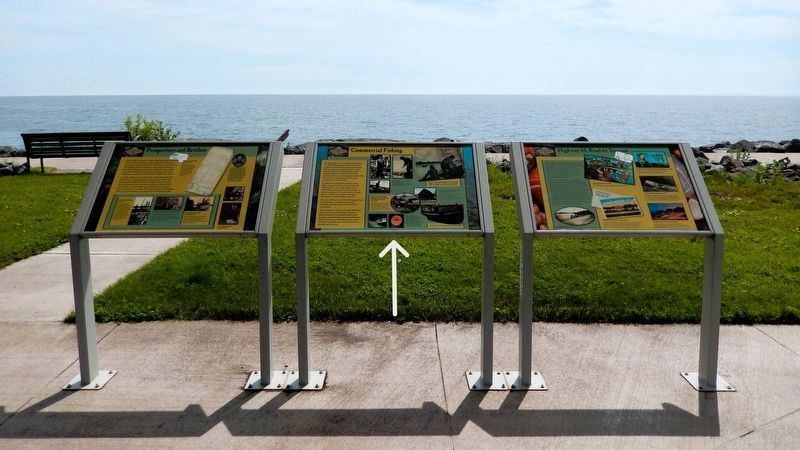
Photographed by Cosmos Mariner, June 24, 2024
5. Commercial Fishing Marker
This is the center one of three panels on the north side of the McQuade Small Craft Harbor interpretive kiosk.

Photographed by Cosmos Mariner, June 24, 2024
6. McQuade Small Craft Harbor Interpretive Kiosk
The interpretive kiosk is on the south side of North Shore Drive, overlooking Lake Superior. Access to the kiosk is from the parking lot on the north side of North Shore Drive. There is a pedestrian access tunnel under the highway. This is the 2nd from the left of six interpretive panels in the kiosk.
Credits. This page was last revised on February 23, 2025. It was originally submitted on February 22, 2025, by Cosmos Mariner of Cape Canaveral, Florida. This page has been viewed 165 times since then and 41 times this year. Photos: 1, 2, 3, 4, 5, 6. submitted on February 23, 2025, by Cosmos Mariner of Cape Canaveral, Florida.