Gilroy in Santa Clara County, California — The American West (Pacific Coastal)
Ranchos and Growth
Cómo se desarrollaron los ranchos
Photographed by Joseph Alvarado, April 17, 2022
1. Ranchos and Growth Marker
Click on the picture to see more information on the inset images.

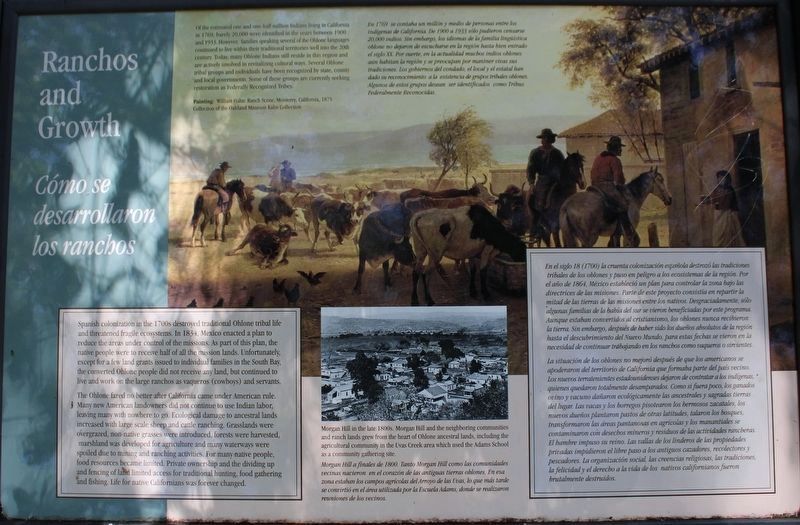
Spanish colonization in the 1700s destroyed traditional Ohlone tribal life and threatened fragile ecosystems. In 1834, Mexico enacted a plan to reduce the areas under control of the missions. As part of this plan, the native people were to receive half of all the mission lands. Unfortunately, except for a few land grants issued to individual families in the South Bay, the converted Ohlone people did not receive any land, but continued to live and work on the large ranchos as vaqueros (cowboys) and servants.
The Ohlone fared no better after California came under American rule. Many new American landowners did not continue to use Indian labor, leaving many with nowhere to go. Ecological damage to ancestral lands increased with large scale sheep and cattle ranching. Grasslands were overgrazed, non-native grasses were introduced, forests were harvested, marshland was developed for agriculture and many waterways were spoiled due to mining and ranching activities. For many native people, food resources became limited. Private ownership and the dividing up and fencing of land limited access for traditional hunting,
this page online
Of the estimated one and one-half million Indians living in California in 1769, barely 20,000 were identified in the years between 1900 and 1933. However, families speaking several of the Ohlone Languages continued to live within their traditional territories well into the 20th century. Today, many Ohlone Indians still reside in this region and are actively involved in revitalizing cultural ways. Several Ohlone tribal groups and individuals have been recognized by state, county and local governments. Some of these groups are currently seeking restoration as Federally Recognized Tribes.
La situación de los ohlones no mejoró después de que los americanos se apoderaron del territorio de California que formaba parte del país vecino. Los nuevos terratenientes estadounidenses dejaron de contratar a los indígenas, quienes quedaron totalmente Desamparados. Como si fuera poco, los ganados ovino y vauno dañaron ecológicamente las ancestrales y sagradas tierras del lugar. Las vacas y los borregos pisotearon los hermosos zacatales, los nuevos dueños plantaron pastos de otras latitudes, talaron los bosques, transformaron las áreas pantanosas en agrícolas y los manantiales se contaminaron con desechos mineros y residuos de las actividades rancheras. El handre impuso su reino. Las vallas de los linderos de las propiedades privadas impidieron el libre paso a los antiguos cazadores, recolectores y pescadores. La organización social, las creencias religiosas, las tradiciones, la Felicidad y derecho a la vida de los nativos californianos fueron brutalmente destruídos.
Topics.

Photographed by Joseph Alvarado, April 17, 2022
2. Ranchos and Growth Marker
Location. 37° 1.767′ N, 121° 39.424′ W. Marker is in Gilroy, California, in Santa Clara County. It can be reached from the intersection of Watsonville Road (County Road G8) and Burchell Road, on the right when traveling south. The marker is mounted to a metal stand on the trail just below the parking lot of the Chitactac-Adams Heritage County Park. Touch for map. Marker is at or near this postal address: 10001 Watsonville Road, Gilroy CA 95020, United States of America. Touch for directions.

Regionally, this marker is in the San Francisco Bay Area and on the Coast Ranges. It is also on the American Pacific Coast. Globally, it is in North America, on the Ring of Fire, on the Pacific Rim, in the Western Hemisphere, in the Western World, and in the Anglosphere. Historically, it finds itself in what was once New Spain and also Mexico’s Alta California.
Other nearby markers. At least 8 other markers are within walking distance of this marker: Round House (within shouting distance of this marker); Arrival of the Spanish (within shouting distance of this marker); Uvas Creek (about 300 feet away, measured in a direct line); Chitactac-Adams Heritage County Park (about 300 feet away); A journey of a Lifetime (about 400 feet away); Food Processing (about 400 feet away); School Days (about 500 feet away); Ohlone Buildings (about 600 feet away). Touch for a list and map of all markers in Gilroy.
Also see . . . Chitactac-Adams Heritage County Park. "This beautiful and culturally significant 4.5 acre park site is located just minutes from the cities of Gilroy and Morgan Hill." (Submitted on May 22, 2022, by Joseph Alvarado of Livermore, California.)
Credits. This page was last revised on May 24, 2022. It was originally submitted on May 22, 2022, by Joseph Alvarado of Livermore, California. This page has been viewed 283 times since then and 19 times this year. Photos: 1, 2. submitted on May 22, 2022, by Joseph Alvarado of Livermore, California. • Devry Becker Jones was the editor who published this page.